Stormy Raindrops

Painfully honest personal experiences with Mental Illness

This blog is not about a success story. It’s a personal rock bottom needing an outlet. This is the brutal reality living inside my head without censors.

Table of Contents

  • Post #21 What Is Post-Traumatic Growth?

    We’ve all heard of post-traumatic stress and its disorder, PTSD. It’s like when we’re triggered by benign sights, sounds, smells, and touches due to a past event that was terrifying to experience or witness, and it gives us symptoms that last well beyond the occurrence of the event.

    I learned something that can happen in us that we may not recognize, which is about post-traumatic growth. It’s when something positive comes out of our negative experiences that change the way we look at life, at what we do with our lives. It doesn’t mean we don’t suffer as a result of the traumatic event; we can even develop PTSD from it. But somewhere during and maybe after suffering, you might find a new viewpoint in life, a new purpose that’s healthy and makes you flourish. Somewhere, there’s a positive consequence of trauma.

    I hope to get there one day. I hope I can be able to drive back to the hospital where I went through 1 year of electroconvulsive therapy without wincing at the thought of the streets you take to get there. I had collected bags of board games, books, adult coloring books to donate to the psych ward for the inpatients. Well, I failed because I couldn’t bring myself to drive back to the hospital and I ended up donating everything to Goodwill.

    How do I turn my suffering into growth? So far, I’m doing something I never felt comfortable doing – sharing my experience with mental illness: I’m doing it through this blog and I’m participating in NAMI Support Groups. My hope is to reach the individuals going through anxiety and depression who won’t necessarily talk about it with a friend or with a group of people going through the same thing.  Like me once, people suffer in silence for any possible category of reasons. There are also people like me who wish to remain anonymous, and maybe eventually, I won’t feel so inhibited doing so.

    Post-traumatic growth may not happen at all and it doesn’t mean you didn’t try hard enough and it doesn’t mean failure. If anything, your trauma and suffering can perhaps give you HOPE that, at the right moment, finds you meaning.
    Thank you for your comment!

  • Post #20 On Finding Purpose In Life When You’re Chronically Sick

    August 15, 2025

    As I’m sitting in front of my computer, in my pajamas and with no agenda for the day, I couldn’t help but think that there has to be more in life than this. I sometimes feel like the living dead, albeit trying very hard to make each day count toward my recovery from depression. But, of course, I sometimes fail the day and it counts toward nothing.

    I happened to take an online course on Coursera on “Finding Purpose and Meaning In Life: Living for What Matters Most.” While it helped me identify my personal values and showed me studies proving that having a purpose in life is incredibly profound to one’s health, decisions, and resilience, I found it very difficult to think of a purpose in my life. I couldn’t create my life’s purpose statement and left it blank.

    When you’re personally suffering from illness, it makes you self-centered because you’re too focused on alleviating your own suffering, feeling better and recovering; hence, it’s challenging to think of others and to think of a purpose that’s greater than yourself. I know because I’ve been managing depression and anxiety for years now, and I just want to heal. I can’t do anything for anyone like this.

    I never grew up with religion, so I don’t have a God’s purpose for me. I wasn’t raised with God’s purpose – I always felt I was on my own. I became spiritual later in life, however, but my thoughts don’t go there by default. I constantly need reminder that I was made for a reason, but what?

    I discovered through the course that if I continue striving for something greater than my sickness, even if it means focusing solely on my recovery and not my misery, I can write as I do now to let others know that they are not alone. I’ve learned through NAMI support groups that it helps to feel understood and to belong to a group who knows your grief, your sorrow, your anguish. It’s just a hope that anyone will read this. But in my mind, at least I can imagine that my suffering can be turned to meaning one day.

    Even if you don’t have a blog or public outlet, share your experience when it’s appropriate: to a stranger, a friend, a family member, a classmate, a colleague. It’s not complaining; it’s sharing and connecting through your pain. It’ll mean something to someone out there. That’s a purpose.

    Thank you for your comment!

  • Post #19 Relapsing Into Depression – 1 Month Later

    Image I found while doom scrolling on Facebook – just loved it!

    August 12, 2025

    I was 1 year and 7 months free from depression symptoms until my relapse one month ago. My psychiatrist cracked some corny jokes which made me literally laugh out loud, so he said that the depression symptoms were mild and we were still in the early stages. Yes, the corny jokes meant he actually tested if I still had my sense of humor. Because I was responsive, I could take action and possibly reverse the course of my symptoms so they don’t get any worse and I could possibly feel better.

    He emphasized me to focus on the Bio–Psycho–Social of total well-being and to work on EACH.

    Imagine yourself as a three-legged stool, with each leg representing Bio, Psycho, and Social. If one leg goes wobbly, then my whole balance is off. I had to make sure I checked each leg to ensure that I had something going on for each so it didn’t go weak on me.

    Here were his instructions:

    Biological (Bio) – focuses on my body and brain chemistry.

    1. Increase anti-psychotic medication by 50 percent.
    2. Exercise 30 minutes 5x/week
    3. Eat a healthy diet
    4. Get enough sleep

    Psychological (Psycho) – focuses on my mind and coping skills

    1. Return to regular sessions with my talk therapist

    Social – focuses on my relationships and environment

    1. Schedule social events and travel on my calendar to anchor my mind into the future with positive things

    ((It definitely is more complicated than that so, if you’re interested, you can always look it up and there are general websites and academic websites that refer to this approach.))

    It’s been two weeks since that appointment and I can definitely say that things are improving. I’d like to say it’s mostly the medication but that would be neglecting to acknowledge my efforts during this time in following my psychiatrist’s instructions.

    So I kept a log of what I was doing the past month, although doing poorly, but still doing:

    1. Increased anti-psychotic by 50% daily
    2. Resumed 2 sessions with my talk therapist
    3. Scheduled 2 social interactions on my calendar
    4. Got out of the house to exercise 4 times
    5. Participated in a virtual NAMI Support Group once
    6. Started a couple courses on Coursera

    So I included the image with this posting because getting started on the these things was HARD! I didn’t WANT to do any of it, with my depression symptoms controlling me right now. But I did so very UNWILLINGLY and therefore half-assed basically, but that’s when you give yourself some grace and say “GOOD ENOUGH” is actually victory.

    Thank you for your comment!

  • Post #18 When My Anxiety Wins and I Lose

    August 3, 2025

    My anxiety has been debilitating lately. I wonder how much of it is in my head and how much of it is in my biology. I have a psychiatrist who diagnoses me and a psychotherapist who doesn’t really believe in mental illnesses. I have medication that alleviates my anxiety, an actual chemical component, which makes diagnoses useful.  But I also have behavioral strategies to deal with anxiety without pills. Usually, my anxiety wins and my strategies go out the window.

    Anxiety is more painful to me than depression. With depression, I am apathetic and my mind goes numb. With anxiety, it’s the strongest emotion I’ve ever felt, and it comes with a desperate, desperate need for relief. If I didn’t believe in god, I would if he could make my anxiety go away. It never gets easier and I’ve had it for almost 40 years.

    My anxiety doesn’t come with a reason that I can rationalize myself out of. That’s the scary part – I don’t know what to fix. I just wish I can tell my mind that it’s okay to rest, that it’s okay to take a break. I don’t need to worry so much to survive. I wish I can convince my mind that it’s not necessary to work so hard. I’m tired, and my body is tired from it. I had no idea my mind was so strong, just not the way I wanted.

    Maybe it’s because I fear too much of so much. Maybe it’s because I can’t persuade my mind that my world is safe. Anxiety, not depression, is what causes me to think of death. Anxiety tells me it’s okay to die and I’m not even suicidal. Because death would be merciful to my soul than to suffer from anxiety. I’m not afraid of death because it’s so much harder to live. Don’t get me wrong – I want to live. I just understand the suffering souls who don’t.

    Thank you for your comment!

  • Post #17 Why We Got A Dog For My Depression – Perks and Pitfalls

    August 1, 2025

    Today, I kept my dog Charlie home from daycare. I felt I could use his company to keep me from feeling lonely and anxious. I am currently job searching after a long-term medical leave of absence, so I’m essentially home every day. But due to multiple chronic conditions that keep me from being consistently able to care for Charlie on a day-to-day basis, daycare has saved me many times.

    My husband and I got Charlie in 2021 when my latest bout of depression led to a medical provider recommending that we get a dog to ease my symptoms. (This was the depressive episode that ended up lasting three years until the end of 2023.) Doug had always wanted a dog too but not me, because . . . well, I don’t know. I wanted to keep the house pristinely clean, etc. etc. etc. I never grew up with a pet.

    I didn’t know at the time that this little guy would be one of the best things to happen to me. I’d like to describe getting a dog is like getting a heart transplant – you have no idea how much bigger your heart gets when you get a dog, how much more love you had in you, and you witness the definition of a pure and innocent soul. I see the living world in a totally different way now, full of creatures with personality, preferences, and feelings. He gives me so much joy even in times I’m crippled with mental illness.

    One pitfall is my inability on days to take care of Charlie’s needs when I’m massively debilitated by depression or fibromyalgia. We live in a townhouse with no yard, so he needs at least three outings a day: morning duties, mid-day walk, evening duties. I can’t always provide that, so we found a daycare for Charlie for those days. Another pitfall is it can get quite expensive, needless to say, but definitely necessary for Charlie’s well-being.

    I’m lucky I have a husband who can take care of him before and after work. But if I were by myself, I don’t know what I’d do. Taking care of a dog is a huge responsibility but it comes with massive rewards. You couldn’t ask for a better companion, but it comes with work that you may not always have the ability to maintain. Charlie definitely alleviated my depression, but I can’t deny the anxiety that can sometimes come from caring for his needs or the guilt that comes from having your spouse do all the caring.

    These are just some things to think about. When you get a dog, it’s not just about your needs. There are other ways to get the benefits of a canine companion without the finance or responsibility, such as volunteering at your local dog shelter to walk or play with dogs in need.

    Thank you for your comment!

  • Post #16: Relapsing Into Depression After 1 Year In Remission

    July 31, 2025

    After being clinically depressed for three years and having to go through electroconvulsive therapy (ECT) for one of those years, I was thrilled in June 2024 to be in remission from depression. It means that I’ve been without depression symptoms for approximately 6 months. I had been doing so incredibly well the past year in remission, looking for a job, starting my blog, working out in aquatic classes, taking online classes, and generally taking small steps to regain my health again.

    It’s unfortunate that I’ve now relapsed back into my depression symptoms. It started a little over two weeks ago when, every day, I looked at the clock every 30 minutes to see how much longer I had to wait for bedtime so I can start over again to feel better. I just wanted to numb myself because I had no energy or concentration to continue what I was doing before and all I could do was scroll through short videos on YouTube all day in bed. I didn’t want to leave the house. Some days, I needed my husband call off work and stay with me at home because I was afraid to be alone. I had anxiety about how I was supposed to go through each day doing nothing, especially when initially there was so much I could be doing. But I can’t. Everything is just so damn hard to do.

    After two weeks of this, I contacted my psychiatrist who confirmed I’ve relapsed. He explained that depression is chronic, and said that there was an 85% chance people would relapse if they’ve had three or more episodes of clinical depression. He tested my sense of humor and, luckily, his corny jokes still cracked me up, so the depression is mild at this point and can possibly be reversed with medication change and behavioral changes:

    • Small increased dose of my antipsychotic, Latuda. I suggested upping my Prozac but I’m already taking 60 mg and my doctor didn’t think that increasing it would have a greater positive effect.
    • Have regular sessions with my talk therapist again.
    • Exercise at least 30 minutes, 5x a day.
    • Eat healthfully.
    • Get enough sleep. I have insomnia and take Ambien nightly, but still, it’s a challenge sometimes staying asleep.
    • Schedule social things on my calendar, so I have something to look forward to. This supposedly anchors my thoughts into the future with positive things.

    I’m writing this early morning while I’m on my caffeine high but, typically, things go downhill from there. I’m optimistic but I’m more scared. I can NEVER, EVER go back to ECT again. I can NEVER be treated by Spravato (esketamine) again. I know this is thinking maybe too far down the line but I’m falling back to fear and the unknown – what if I’m unable to reverse the course of this depression. God, I’ve said before you came too late in my life. If you’re here, come now.

    Thank you for your comment!

  • Post #15 Inside Psychiatric Wards – 5 Possible Consequences After Discharge

    It’s best to be prepared for the possible consequences after being discharged from a psychiatric ward. There may be setbacks or what feels like rejection for continued professional help, but in my personal experience, these misfortunes led to far better longer-term care for me in the end.

    1. There are no discharge instructions on how to manage life after hospitalization.

      It’s much better to have a plan in place while you’re still in the hospital. If you have a job, going back to work can put in place a routine and solid structure to get you back to equilibrium.  If you don’t have a job, it’s important that you have a plan in place before discharge, especially where you can interact with others and have somewhere to go to get you out of the house. I can’t stress how important this can be for further recovery or else you end up lost and directionless like I was. Sign up for a gym or search for non-credit classes to take for personal development at your local community college. Create an inspiring playlist to turn to for motivation or create a list of books you’ve always wanted to read. Find something you can look forward to.

      2. You may have a waiting period before some mental health companies can provide you assistance.

      After my third hospitalization, my outpatient psychiatrist for medication management recommended that find someone specializing in talk therapy so that I can have both specialties contributing to my care. Unfortunately, my first experience in trying to find a psychotherapist wouldn’t take in new patients unless they had been out of the psychiatric unit for at least 3 months. There may be many reasons, but the explanation given to me was that I would be deemed too high risk for attempted suicide.

      3. Individual talk therapists may not be qualified to help you.

      Selecting a talk therapist, if you don’t already have one, can be in and of itself a challenge. But it can be an even bigger challenge when you disclose that you’ve recently been discharged from a hospital’s psychiatric ward, because some psychotherapists may not have the tools to support your needs. Don’t take this honesty as a rejection but as an opportunity to get quality help with someone who has the knowledge and experience to help you.

      4. Your outpatient psychiatrist may not want you back.

      This happened to me after the first time I was discharged from the psychiatric ward 15 years ago from the time I write this.  My former outpatient psychiatrist, who I had been seeing for a couple years, didn’t want me back. He explained to the hospital psychiatric doctor that I was a “troubled and noncompliant patient,” and he didn’t want me as his patient any longer. Even knowing that it would leave me compromised without medical assistance for the short term, he reiterated to the hospital staff he did not want me back.

      In at least two phone calls, the hospital psychiatrist told him that what he was doing was unethical and that he had to take me back or else I would not have a mental health physician after discharge. They later explained what happened to me so that I would be fully aware of what I was going back to. I hope that what happened was incredibly rare, but if this happens, understand that not all psychiatrists are compatible with their patients. You have every right to find another doctor you can trust and respect. You deserve excellent care and a doctor committed to your well-being.

      5. You may not return to the psychiatric ward where you were hospitalized to volunteer.

      When I was in remission from depression, I had my heart set on volunteering at the psychiatric ward where I was hospitalized for one month. Unfortunately, they said that I could not volunteer “indefinitely” as a result of being hospitalized at the same unit. I can understand how hospitals may have had to create this rule, but I was personally devastated. I felt like my free labor was not of any value – it was the toughest pill to swallow.

      Nonetheless, this was an opportunity divert course and, being formally educated and employed as an instructional designer, I offered to volunteer remotely by creating worksheets for inpatients to do in their downtime. The leadership considered my proposal to create a workbook for inpatients as a person with lived experience being hospitalized and it was decided that a workbook might be worthwhile. After submitting several example worksheets, the psych leadership gave me approval to proceed until it is complete for their review. It is currently a slow-going work in progress but it’s a reminder to me that I am on track to recovery by reframing situations positively in my favor.

      Thank you for your comment!

    1. Post #14 Inside Psychiatric Wards – 10 Items You Can Have Friends/Family Bring In For You

      1. Comfortable clothing

      Unless you want to stay in those blue gowns that are open in the back, you’re allowed for friends and family to bring you clothes for fit, coverage and comfort including T-shirts, sweatshirts, sweatpants and shorts. Just make sure that the drawstring for sweatshirts and sweatpants are pulled out because you can’t have any cords in your possession. Shirts shouldn’t have foul words or language.

      Hack: If no one can bring you clothes, and you must stay in the blue gown, always ask to wear two gowns. The first layer is to have the gown open in the back and the second layer is the gown opening in the front = instant coverage.

      2. Underwear and socks

      The hospital has disposable underwear for patients that’s made of thin white gauze material and meant to stretch and fit most people. The good thing about that is that you don’t have to wash the only underwear you wore when you were admitted. But you’re allowed underwear that fits if brought in/dropped off by a visitor. Trust me, this is important or else you’re pulling up your underwear every minute or pulling out wedgies.

      3. Slip-on shoes or sneakers

      Upon admission, you are given socks with white traction strips at the bottom to prevent you from slipping. They are all one-size since these socks are without heels, so they will slip down or get stretched out if you don’t ask for a new pair daily. Ask friends or family to bring you slip-on shoes or sneakers so you can walk comfortably. Just know that shoelaces must be pulled out because ties of any kind are not allowed.

      4. Toiletries

      Hospital lotion is pretty watery so I asked for my husband to bring my personal lotion. You’re allowed your other personal toiletries too as long as there are no razor blades or anything else that has glass or metal.

      5. Phone and charger

      Your cell and charger will be kept behind the front desk for safekeeping until the open window for cell phone privileges. It’s important to remind the staff to charge your phone or else you lose the 1- or 2-hour window you’re allowed to have it in your possession, like in your room if you wish to speak privately. Trust me, it can be heartbreaking not being able to reach out to others when you’re locked inside.

      6. Books/magazines

      While there are books and magazines available to patients to read, they may not always be the genre you prefer reading. Having a book or magazine as a companion is always a safe bet when you feel you need to occupy yourself during quiet times.

      7. Journals

      Most psychiatric wards I stayed in gave me a thin notebook and pencil for writing and you can always ask for more. If you prefer to write in your own journal, ensure that it doesn’t have spiral binding. No pokey metal.

      8. Pictures

      One time, I was hospitalized for a month without being able to receive any visitors because it was in the middle of the COVID pandemic. Pictures helped me get through the challenges of being completely separated by family. Pictures in frames may be prohibited unless the glass is taken out, but the edge of frames may be iffy for staff. It’s safer to keep pictures loose; they also make great bookmarks.

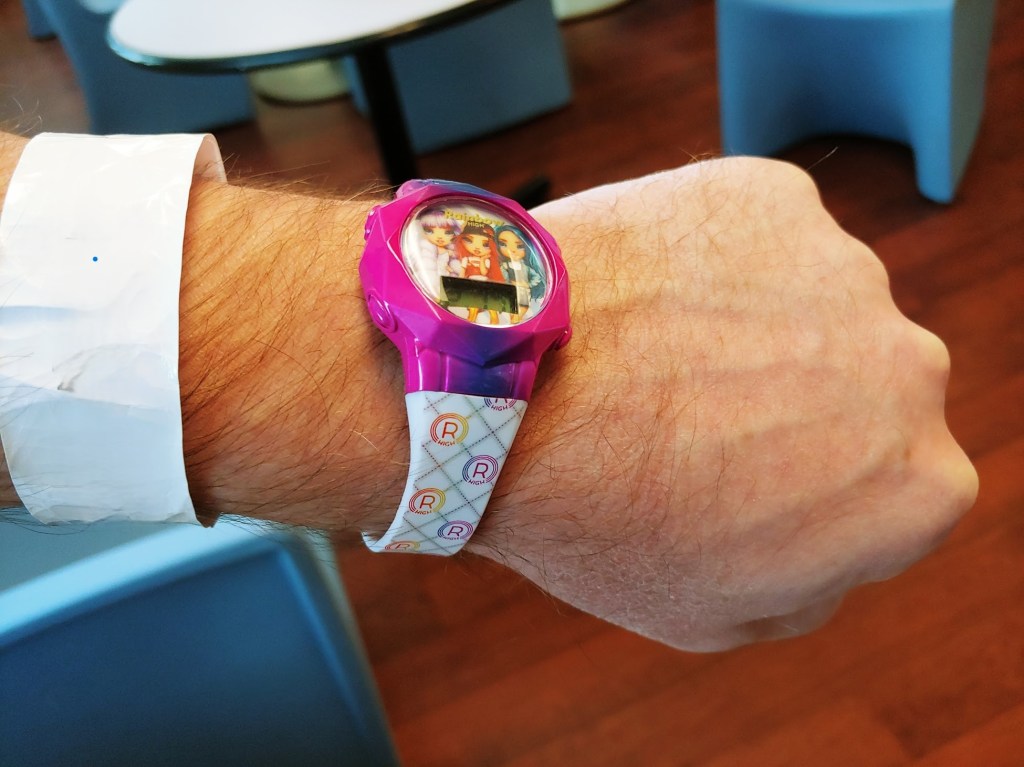
      9. Watch

      For those of you who are used to wearing watches or like to be keenly aware of the time, my fellow hospital friend Wayne was able to keep a children’s watch that was plastic and pretty risk-free. See the picture above.

      10. Favorite Snacks

      Plenty of snacks were always available for patients to enjoy at any given time like chips and granola bars. If you crave to have your favorites, there’s nothing wrong with anyone bringing you your favorite candy bars and other snacks.

      Thank you for your comment!

    2. Post #13 Inside Psychiatric Wards – 4 Challenges When Friendships Last Outside Hospitalization

      You have a lot of time in psychiatric wards and it was worthwhile for me to connect with other patients. I could have opted to stay in my room all day, but eventually I knew I would meet people in the dining room, the shared recreation room/living room, or just by walking up and down the hallway for exercise. You’re not prohibited from talking to anyone nor are you prohibited from discussing any topics. You can make friends while in the psych unit and, in my experience, it was wonderful to talk to people who I felt could understand me.

      It’s actually a beautiful bond to have friends with whom you’ve shared a very personal experience during a mutually vulnerable time in your lives. You can spend many hours and many days with your friends and get to know them on a deeper level simply because of the definition of where you are – in a psychiatric ward. With that comes questions that may not come up anywhere else: Why are you here? What condition do you have? What did you do?

      It’s understandable to want to keep these friendships when you get out of the psych ward. I did for some time. Sadly, these relationships couldn’t last. These four challenges come from personal experiences with my own friendships that started at the hospital.

      1. It’s challenging to maintain with the friendship due to your own ongoing problems.

      I think you’re never fully recovered when you’re discharged from the hospital; your mood is most likely more stable and you’re not a danger to yourself or others. You still have a lot more to work on, and you simply may not have the bandwidth to sustain a new friendship as you normally would.

      2. It’s challenging when your friend’s mental illness becomes unmanageable for you.

      There are many types of patients grouped together in the psychiatric ward. Everyone comes in with a different mental illness, different trauma, varying levels of severity, and the unique way this person needs help. Maintaining a friendship outside the psych ward, it’s possible they may come to you when their symptoms are heightened and you don’t know how to help. This is distressing in and of itself, but you also may not be able to support them while you’re dealing with symptoms of your own at the same time.

      3. It’s challenging to talk about attempted suicide.

      Not everyone in a psych ward goes far enough to try and end their lives, but chances are likely you will encounter someone who attempted to. When the topic comes up of, “how did you do it,” which it sometimes does, it may be heartbreaking and difficult to hear. Their answers always remained in my memory. In my darkest moments, I used to say that you go to psych wards to learn ways how NOT to kill yourself if you want to succeed. This is not how I feel now, because psychiatric units give our lives the stillness, contemplation and help we so desperately need. Still, there are some things I know now that I wish I didn’t.

      4. It’s challenging to be a therapist for your friend.

      Your friend may inadvertently use you as a therapist and anything can go wrong. You especially can’t be a therapist to a friend who is at risk of hurting themselves or others. They may unknowingly put you in a scenario that may inflict trauma because you’re desperate to alleviate their distress and don’t know how. Their behavior may trigger you in ways that you don’t anticipate, which compromises your own mental health or recovery.

      Thank you for your comment!

    3. Post #12 – Inside Psychiatric Wards – 10 Things To Expect

      I had been hospitalized in three different psychiatric wards in the past 15 years. Each time was at a different hospital, from one week to as long as one month. Though each psychiatric ward is unique, there were characteristics they all shared. Here are 10 things on what to expect if you ever anticipate being hospitalized.

      1. You’re locked in.

      Once I was admitted into a hospital’s psychiatric ward, the doors are locked from the inside. The entrance and exits are marked with signs that warn hospital staff of patients escaping from the ward. Sometimes, I had my own room. Sometimes, I had a roommate.

      2. Expect to be monitored.

      My actions were observed and recorded, including who I made friends with. If I was in my room alone, psych nurses would poke their heads in on regular rotations. There was no privacy except the bathrooms. There are doors within the ward that you can close, like to the showers, bedrooms, and meeting rooms, but none that I could lock.

      3. You get phone privileges for only 1 or 2 hours a day.

      My cell phone was taken away except for the 1- or 2-hour window every day (varying by hospital) that I was allowed to use it. You have to rely on the hospital staff to charge it for you, since patients aren’t allowed to keep their own chargers with them. The problem with that is that you’re out of luck for the day if the staff forget to charge your phone.

      4. You will have no access to string, cords, metal, glass with sharp edges.

      Visitors are allowed and they can bring you items; however, everything is checked for safety purpose so patients can’t hurt or kill themselves. If you are given a hoodie or sweatpants, the drawstrings need to be removed. If you are given sneakers, the shoelaces must be removed. Anything with glass or metal is prohibited. Anything with sharp edges, of course, is prohibited.

      5. Recreational activities are minimal.

      You can only use a pencil or marker to write. Depending on the hospital, the activities available to you are varied. There’s always a television. There are typically some books, board games, puzzles, and crayons and markers to draw. In one hospital, we were lucky to have one computer to share among the patients.

      6. Three meals are provided daily.

      You are given three meals a day at scheduled times and sometimes you can select what you want from a list. We were given plastic forks and spoons, plastic trays, plates, cups and bowls. No plastic knives.

      7. Brief visits with psychiatrist daily.

      You see a psychiatrist once a day except weekends. The visit is very brief. There is no talk therapy involved (meaning, you don’t discuss your childhood or deep-rooted issues); it is a discussion of the symptoms you are experiencing and the medications involved.

      8. You can make friends.

      You’re allowed to make friends. There are no topics you’re prohibited from discussing. If they happen to have an episode of heightened symptoms, you are not allowed to assist.

      9. There is nothing scheduled on weekends.

      Expect ZERO scheduled sessions with a healthcare provider on weekends. You receive your three scheduled meals, your medications, and that’s it. You’re on your own in terms of how you keep yourself occupied.

      10. You will have a lot of time to yourself.

      There is a lot of down time, even on weekdays. Usually there was a 1-hour group activity with other patients where you make drawings on select themes. I have never received one-on-one talk therapy or group therapy while in the psych ward.

      Thank you for your comment!